
Recently, the research group published a paper titled "Atom-optically synthetic gauge fields for a noninteracting Bose gas" in the journal Light: Science & Applications. Professor Li Yuqing from our group is the first author, with Professors Ma Jie and Mei Feng serving as corresponding authors. Professors Jia Suotang, Xiao Liantuan, and others also contributed significantly to the study.
Charged particles moving along a closed loop experience a phase shift, which serves as a basis for exploring topological phenomena in condensed matter physics. For neutral particles such as atoms and photons, it is possible to construct synthetic magnetic fields, or artificial gauge fields, by introducing a path-dependent geometric phase that mimics the effect of an orbital magnetic field on charged particles. This approach allows for quantum simulations of complex physical systems by replicating the Hamiltonian of charged particles. Ultracold atomic quantum gases, with their exceptional controllability, provide an ideal platform for studying artificial gauge fields.
Experimental studies have already observed chiral edge states and topological properties under artificial gauge fields. However, these systems typically involve some level of atomic interactions. To fully explore single-particle tight-binding Hamiltonian control, it is necessary to investigate artificial gauge fields in non-interacting ultracold atoms.
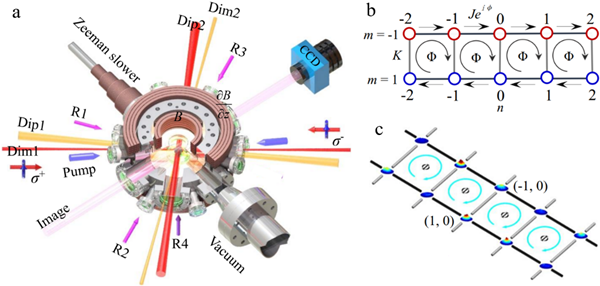
The research team has, for the first time, synthesized a two-leg ladder potential using a one-dimensional momentum lattice in a non-interacting Bose quantum gas. By introducing tunneling phases, they realized an artificial gauge field within the two-dimensional ladder potential under non-interacting conditions. The team investigated the population dynamics of atoms in the presence of a uniform artificial magnetic field and observed chiral atomic flows. Furthermore, they studied the influence of coupling strength along the ladder’s vertical direction on the chiral flow, which is crucial for better understanding chirality in artificial gauge fields. In addition, by constructing a non-uniform artificial magnetic field, they explored atomic transport properties in the non-uniform field, discovering that atomic transport within the ladder can be controlled by locally tuning the gauge flow. The experimental results align well with a tight-binding model for non-interacting single particles.
The artificial gauge field synthesized with a non-interacting Bose quantum gas provides an ideal experimental platform for studying various non-interacting single-particle models. Moving forward, by employing Feshbach resonances to tune interatomic interactions, the team aims to explore the effects of interactions on artificial gauge fields and topological physics, which holds significant implications for quantum simulations of strongly correlated physics.
This work was supported by funding from the National Key Research and Development Program, the NSFC Key International Cooperation Research Project, and the NSFC General Program.
Link to the paper: :https://www.nature.com/articles/s41377-021-00702-7